
PAT Testing in London
Our PAT testing service checks that your portable appliances are safe to use, because damaged plugs, leads and appliances are a common cause of shocks and fires. As a result, you have clear records for your insurer, landlord or health and safety audit.
For example, we test appliances in offices, shops, restaurants, HMOs and rental properties across London. In addition, every item gets a pass or fail label, and you receive a full PAT register.
- NAPIT-accredited
- Calibrated test equipment
- Free quotes
What our PAT testing includes
Every visit follows the same careful process. Therefore, nothing is missed and your records are complete.
Visual inspection
First, we check each plug, cable and casing, because most faults can be seen before any test.
Electrical tests
Next, we test earth continuity and insulation with calibrated equipment. Also, we check polarity on extension leads.
Pass and fail labels
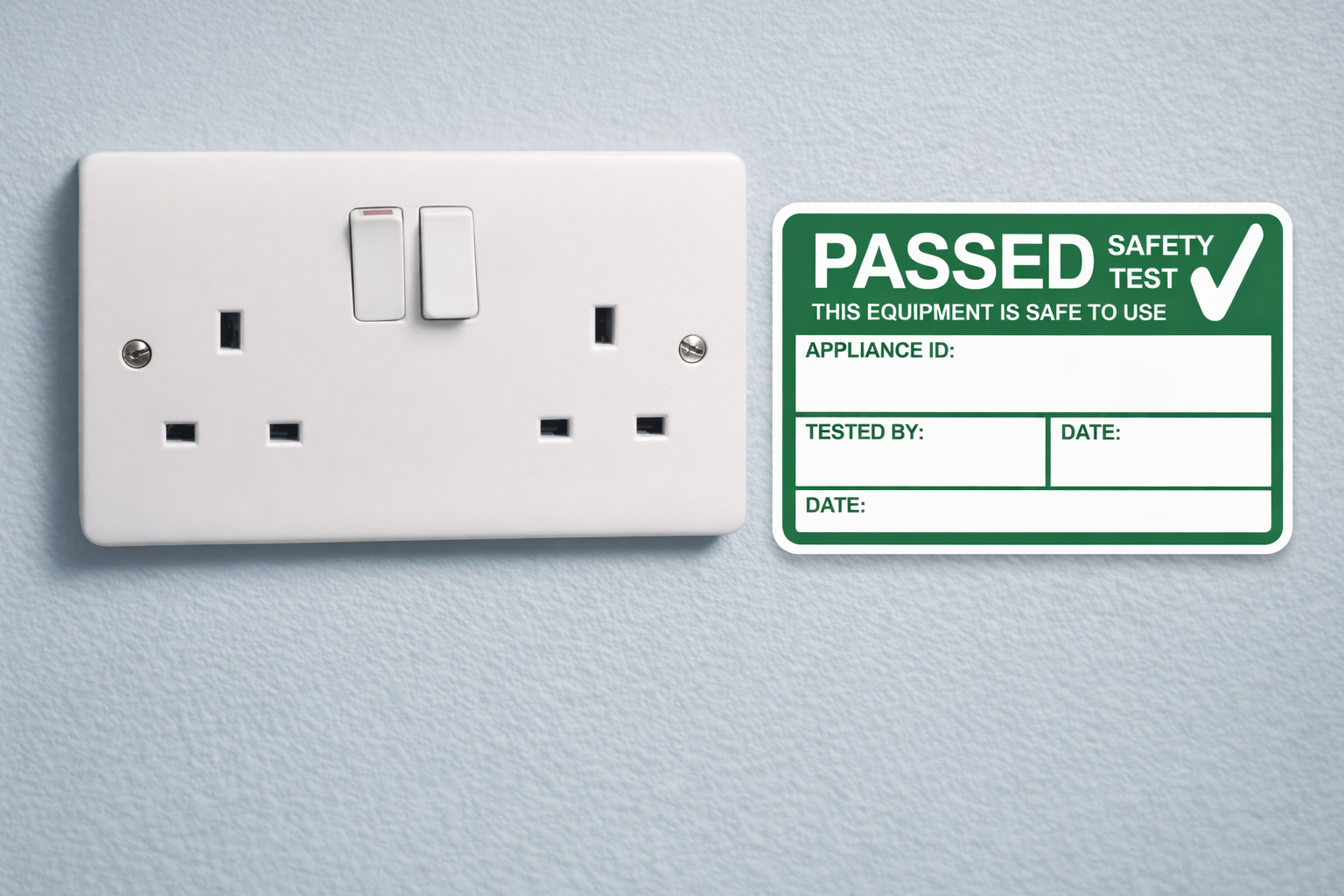
In addition, every appliance gets a clear label with the test date and next test due.
PAT register and certificate
After that, you receive a full register of every item, as well as a certificate.
Failed items
If an item fails, we take it out of use and, therefore, explain whether to repair or replace it.
Minor repairs
Finally, we can often fix simple faults on the day, for example a damaged plug or fuse.
PAT testing and the Electricity at Work Regulations
The Electricity at Work Regulations 1989 require electrical equipment to be kept safe. However, the HSE PAT testing FAQ explains that the law does not set a fixed test interval.
Instead, the frequency depends on the type of equipment and how it is used. For example, the HSE guide HSG107 recommends a risk-based approach, so we advise on the right test interval for you.
Which appliances need testing?
In general, most portable equipment with a plug should also be tested. For example, we cover:
Kitchen appliances
For example, kettles, microwaves, toasters and fridges, because they are used every day.
Office equipment
Also, computers, monitors, printers and chargers in offices and home offices.
Leads and tools
In addition, extension leads, adaptors and power tools, which are often damaged.
Who needs PAT testing?
We provide PAT testing for landlords, businesses and organisations. In particular, we often test appliances in rentals and shared workplaces. In addition, our PAT testing for landlords guide covers HMOs, letting agents and certificates.
When should you book a test?
In short, you should book a visit when:
- You supply appliances to tenants, for example in an HMO
- Staff or, for example, customers use your electrical equipment
- Your insurer or managing agent also asks for records
- Equipment is moved often and, therefore, gets damaged
- Your last test was, for instance, more than a year ago
Also, our PAT testing guide explains why regular testing matters.
Our PAT testing process
Because we plan every visit, testing causes very little disruption.
Book
First, we agree a time that suits you, including early mornings or evenings.
Inspect
Next, we visually check each appliance and also its plug and lead.
Test
After that, we test every item and label it as a pass or fail.
Report
Finally, you receive your PAT register and certificate by email.
5.0 ratingFrom 85 Google reviews
NAPIT-accreditedMembership No. 65117
Clear recordsAlso, every item is labelled and logged
London-wideWe also cover North, North West, West and South West London
More services from our team
In addition, the same team can inspect and protect your property.
EICR
Because appliance testing does not cover fixed wiring, we also carry out EICRs.
Emergency lighting testing
In addition, we test emergency lighting to BS 5266-1 for businesses and landlords.
Fire alarm systems
We also design, install and service BS 5839 fire alarms, for example in HMOs.
PAT testing FAQs
Is PAT testing a legal requirement?
Not in itself, however, the law requires equipment to be kept safe, and regular testing is a recognised way to show this.
How often should PAT testing be done?
It depends on the equipment and, in addition, where it is used. For example, heavily used items on a building site need testing more often than office computers.
Do landlords need PAT testing?
Landlords must also make sure any appliances they supply are safe. Therefore, many letting agents and insurers ask for PAT records. For example, our guide to PAT testing for landlords explains the rules, how often to test and our prices.
What does PAT testing not cover?
It covers portable appliances only. Therefore, the fixed wiring needs a separate EICR.
Will every appliance get a label?
Yes, because each item is labelled with its result, the test date and the next test due.
What happens if an appliance fails?
First, we explain why it failed. Then, we advise whether it can be repaired or should be replaced.
Need your appliances tested?
First, tell us roughly how many items you have. Then, we will send you a free, no-obligation PAT testing quote.
