
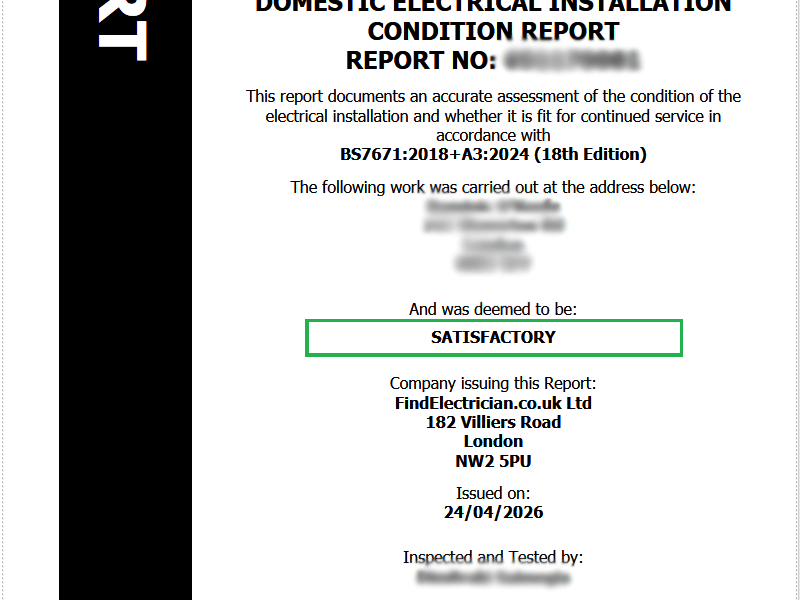
An electrical installation condition report, usually called an EICR, is a safety inspection of the fixed wiring in a building. It checks whether the wiring, fuse board, sockets, switches and light fittings are safe to keep using, and it records anything that needs fixing.
We carry out EICRs every week across London for landlords, homeowners and businesses. This guide explains what an electrical installation condition report covers, how often you need one, what the codes mean and what it costs.
What is an electrical installation condition report?
An electrical installation condition report is a formal report written by a qualified electrician after inspecting and testing an electrical installation. It is sometimes called a periodic inspection report, an electrical safety report or a landlord electrical certificate, but they all mean the same thing.
The report follows the national wiring regulations, BS 7671. At the end, the installation is marked either satisfactory or unsatisfactory, and any problems are listed with a code so you know how urgent they are.
What does an EICR check?
An EICR looks at the fixed parts of the installation, not the appliances you plug in. During the inspection we check:
- The consumer unit (fuse board), including RCD protection
- Earthing and bonding to gas and water pipes
- Sockets, switches and light fittings for damage, overheating or wear
- The condition of cables and wiring we can safely get to
- Circuits in bathrooms, kitchens and outbuildings, where the risk is higher
We then test each circuit with calibrated equipment, so the report is based on readings, not just a visual look. Portable appliances are covered separately by PAT testing.
What do the EICR codes mean?
Every problem we find is given a code:
- C1 – danger present. There is an immediate risk of injury, so we make it safe straight away.
- C2 – potentially dangerous. Not an immediate danger, but it needs fixing urgently.
- FI – further investigation. Something needs looking at more closely before we can say it is safe.
- C3 – improvement recommended. Not unsafe, but bringing it up to the current standard is advised.
Any C1, C2 or FI code makes the electrical installation condition report unsatisfactory. Our guide to C1, C2 and C3 codes explains each one in more detail.
How often do you need an electrical installation condition report?
It depends on who uses the property:
- Rented homes in England: at least every five years, and before a new tenancy starts.
- Homes you own and live in: every ten years is recommended, and when you buy or sell.
- Shops, offices and other commercial premises: usually every five years, or more often for higher-risk buildings.
The electrician who carries out the inspection can also recommend a shorter interval if the installation is old or heavily used. Our article on how often an EICR needs to be done goes into more detail.
Electrical installation condition reports for landlords
Since 2020, private landlords in England must have the electrics in their rental properties inspected and tested at least every five years. You have to give a copy of the report to your tenants within 28 days, and to the local council within seven days if they ask for it.
If the report is unsatisfactory, any remedial work must be done within 28 days, or sooner if the report says so. Councils can fine landlords up to £30,000 for breaking the rules. The full details are in the government guidance for landlords.
Do you need an EICR when buying a house?
It is not a legal requirement, but it is well worth getting. A standard homebuyer survey only gives the electrics a quick visual check, while an electrical installation condition report tests every circuit. That means you know about problems like an old fuse board or a needed rewire before you exchange. See our guide on getting an EICR when buying a house.
How long does an EICR take and what does it cost?
A one or two bedroom flat usually takes two to three hours, and a larger house can take most of a day. The power will be off for short periods while we test each circuit.
Our prices start from £99 for a studio flat, and you will always get a fixed price before we start. Our EICR cost guide shows typical prices for different sizes of property in London.
Book an EICR in London
We are NAPIT-accredited electricians covering North, West and Central London, and we can usually attend within a few days. If anything fails, we can quote for the repairs straight away and issue a new report once the work is done.
Find out more on our EICR service page, read our full guide to EICR certificates in London, or call us on 07447 569653.
