
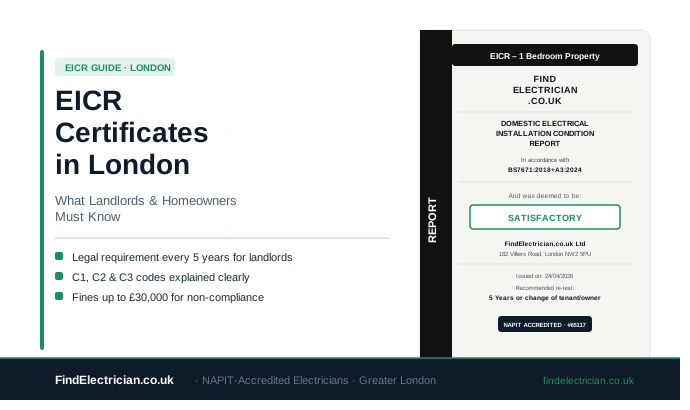
If you rent out a property in London, an EICR is a legal requirement. If you own your home, it is one of the best ways to check your wiring is safe. This guide explains what an EICR is, what it checks, what the codes mean, and what the law says. It also covers costs and what to do if your report is unsatisfactory.
What Is an EICR?
An Electrical Installation Condition Report (EICR) is a formal report produced by a qualified electrician after inspecting and testing the fixed wiring in a property. It is carried out to BS 7671, the UK wiring regulations.
An EICR is not a pass or fail certificate. Instead, it records the condition of the installation and lists any issues, each with a code. As a result, you know exactly what is safe and what needs attention.
What Does an EICR Check?
During the inspection, the electrician checks and tests:
- The consumer unit (fuse board) and its protective devices
- Circuits and fixed wiring for damage, wear and overloading
- Earthing and bonding
- Sockets, switches and light fittings
- RCDs, to make sure they trip quickly
- Signs of DIY or uncertified work
For a full breakdown, see our EICR service page for London.
EICR Codes Explained
Every issue found is given one of four codes:
- C1 – Danger present. Someone is at immediate risk, so the fault must be made safe straight away.
- C2 – Potentially dangerous. Urgent repair is needed.
- C3 – Improvement recommended. The installation does not meet current standards, but it is not unsafe.
- FI – Further investigation. Something could not be fully assessed.
A report is only satisfactory if there are no C1, C2 or FI codes. For a detailed guide, read what happens if your property fails an EICR.
Legal Requirements for London Landlords
Under the Electrical Safety Standards in the Private Rented Sector (England) Regulations 2020, private landlords in England must:
- Have the electrical installation inspected and tested at least every five years
- Give a copy of the report to existing tenants within 28 days
- Give a copy to new tenants before they move in
- Send a copy to the local council within 7 days if asked
- Complete any required repairs within 28 days, or sooner if the report says so
- Get written confirmation from an electrician that the repairs are done
The rules have applied to all existing tenancies since 1 April 2021. Councils can issue fines of up to £30,000 for breaches.
What About HMOs?
The same rules apply to Houses in Multiple Occupation (HMOs). In addition, many London councils make a valid EICR a condition of the HMO licence. Therefore, HMO landlords should keep their report up to date and easy to find. Our guide to how often an EICR is needed explains the timings in more detail.
Do Homeowners Need an EICR?
For owner-occupied homes, an EICR is not a legal requirement. However, it is strongly recommended, usually every ten years. It is also worth getting one when:
- You are buying an older property
- You are planning a renovation or extension
- The wiring has not been checked for many years
- You notice tripping, flickering lights or burning smells
- The property has been empty for a long time
How Often Should an EICR Be Carried Out?
The recommended maximum intervals are:
- Rented homes: every 5 years
- Owner-occupied homes: every 10 years
- Commercial premises: usually every 5 years
The electrician may recommend a shorter interval, for example if the wiring is old. See how often does an EICR need to be done for more.
How Much Does an EICR Cost in London?
Prices depend on the size of the property and the number of circuits. Our prices start from:
- Studio: from £99
- 1-bed property: from £130
- 2-bed property: from £160
- 3-bed property: from £180
- 4+ bedrooms: from £200
We confirm a fixed price before we start. See our EICR in London page for details.
What If Your EICR Is Unsatisfactory?
If your report is unsatisfactory, the electrician will explain each issue and quote for the repairs. Once the work is done, you receive certification to confirm the installation is safe. Landlords must then give tenants and the council written confirmation that the work is complete. For more, read our guide to C1, C2 and C3 codes.
Book an EICR in London
We are NAPIT-accredited electricians carrying out EICRs across London for landlords, letting agents, homeowners and businesses. We can also carry out any repairs your report calls for. Visit our EICR in London page, or call us on 07447 569653.
or drop your contact details with brief description below and we will contact you within 12 hours.
 Posted on Google
 Juan José del Río Holgado
Trustindex verifies that the original source of the review is Google.
Angelo did an EICR on our flat and then came back to fix the two items it flagged. Before booking, he looked at photos of the consumer unit and suggested a better fix than the one I'd asked him to quote for. I had already replaced one item on his remedial quote myself, and he took it off without any fuss. After the remedial work he re-issued the report as Satisfactory at no extra cost, which he'd told me upfront. Fair prices, and I'd use him again.Posted on Google Adam BReally pleased with the work from Dimitri. We needed our annual emergency lighting and fire alarm inspections sorted, along with PAT testing, for our business in Willesden. Dimitri came out, went through everything properly, and talked us through what he found. If your business needs emergency lighting, fire alarm inspections or PAT testing in Willesden, these are the people to call.Posted on Google
 Noah FAngelo installed a new circuit for me. He was responsive, quoted a very reasonable price, and the installation was neat and tidy. I'd be happy to use him again for any future electrical work.Posted on Google
 Dom O'KeefeAngelo and Mo did an EICR check, fixed a couple of issues, and installed two new overhead lights in my flat. They were courteous, knowledgeable, and very professional throughout. I would recommend them to anyone.Posted on Google
 Mike DalmasDimitri and Angelo were very professional and did the EICR on my property on time as. Highly recommended.Posted on Google
 Spiro FerroThe guys(Dimitris and Angelo) were amazing. They arrived on time and completed the work neatly.Posted on Google
 Julian LipsonExcellent electrician and service. So reliable and communicative - very impressed.Posted on Google
 Spiro SDimitri provided a reliable and efficient service. The work was completed on time, and the team was professional and easy to communicate with. Highly recommend DIM Electrical Services(FindElectrician)Posted on Google
 SW7 Construction & Design LtdWe’ve worked with this electrical contractor across many projects over the years, and they’ve been consistently outstanding. Dimo, Angelo and their team are reliable, highly skilled, and always delivers quality work on time. Communication is clear and straightforward, making every project run smoothly from start to finish. They’re proactive, solution-focused, and a pleasure to collaborate with. We wouldn’t hesitate to recommend them to anyone looking for dependable and professional electrical services.

3 Comments
[…] Previous post EICR Certificates in London: What Landlords and Homeowners Must Know Next post What Happens If My Property Fails an EICR? Understanding C1, C2, and C3 Codes […]
[…] is a legal requirement every five years, with strict deadlines for tenants and councils. Read our complete guide to EICR certificates in London for the full […]
[…] to EICRs? Read our complete guide to EICR certificates in London, and see how often an EICR needs to be […]