
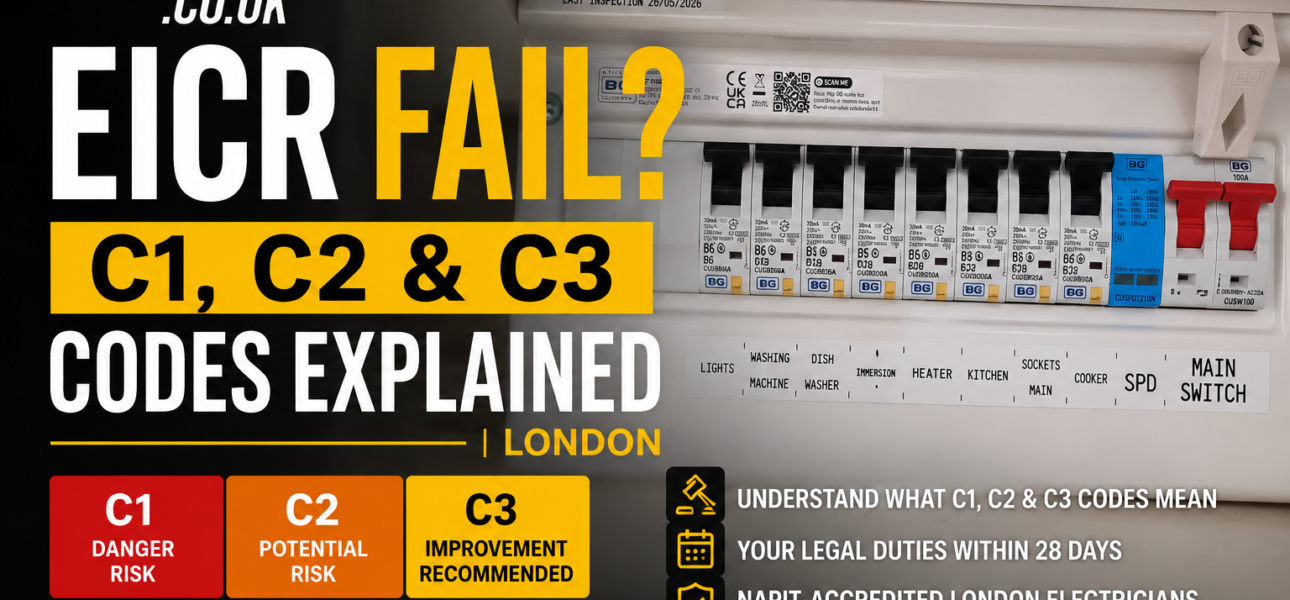
Receiving an unsatisfactory EICR result can feel alarming, particularly if you are a landlord with a tight turnaround between tenancies or a homeowner who was not expecting any issues. But an EICR failure does not mean your property has to go dark overnight. Understanding what the outcome codes actually mean and what you are legally required to do about them will help you respond calmly and correctly.
This guide explains how electricians classify deficiencies on an EICR, what each code requires you to do, and what the consequences are of ignoring the findings. The Electrical Safety Standards in the Private Rented Sector (England) Regulations 2020 set out the legal obligations for landlords in England.
EICR Codes at a Glance
If you only read one section, read this. The table below summarises what each classification code means and what you need to do about it. The detailed explanations follow underneath.
Code | What it means | Action required | Can the property stay in use? |
C1 | Danger present — risk of injury or death | Immediate. The installation should be made safe on the day. | No — the affected circuit must be taken out of use until resolved |
C2 | Potentially dangerous — could become a danger | Urgent. Remedial works within 28 days (landlords). | Yes, in the interim while works are arranged |
C3 | Improvement recommended — not currently dangerous | None legally required, but improvement advised | Yes — report can still be satisfactory with C3s |
FI | Further investigation required | Follow-up inspection of the specific item needed | Depends on the outcome of the investigation |
What Does It Mean to “Fail” an EICR?
An EICR does not issue a simple pass or fail in the way a driving test does. Instead, the inspector records observations throughout the assessment and assigns each one a classification code. The overall outcome of the report is then either:
- Satisfactory: the installation is in a reasonable condition and no urgent action is required
- Unsatisfactory: one or more observations require remedial action before the installation can be signed off as safe
An unsatisfactory outcome does not necessarily mean the property is about to catch fire. It means there are deficiencies that need to be addressed, and the urgency depends on the codes assigned.
The EICR Classification Codes Explained
C1 — Danger Present
A C1 observation indicates that danger exists and immediate action is required. The deficiency poses a risk of injury or death and must be addressed before the installation is used further. In practice, a competent electrician carrying out the inspection should make the installation safe on the day — or at minimum advise you to take the affected circuit or equipment out of use until repairs are completed.
Common causes of C1 observations include:
- Live parts accessible to touch (exposed terminals, damaged accessories)
- Absence of earthing or bonding where a shock risk exists
- Severely overloaded wiring that presents an immediate fire risk
C2 — Potentially Dangerous
A C2 observation means the deficiency is not currently causing danger but has the potential to become dangerous. Urgent remedial action is required, but the installation may continue to be used in the interim while the works are arranged. Under the Electrical Safety Standards in the Private Rented Sector (England) Regulations 2020, landlords are required to complete remedial works and obtain written confirmation from a qualified electrician within 28 days of receiving the EICR (or sooner if the report specifies a shorter deadline).
Common causes of C2 observations include:
- Absence of RCD protection on circuits that require it under BS 7671:2018+A2:2022
- Inadequate earthing or protective bonding
- Deteriorating insulation on older wiring
- Consumer units or enclosures that do not meet current standards — see our consumer unit upgrade service
C3 — Improvement Recommended
A C3 observation means the installation does not meet the current edition of BS 7671, but the deficiency does not present an immediate or potential danger. It is a recommendation to upgrade or improve, not a legal requirement to act.
A report can still be issued as satisfactory even if it contains C3 observations, provided there are no C1 or C2 findings. That said, C3 observations should not be ignored indefinitely. They often indicate ageing infrastructure that may deteriorate over time.
Examples of C3 observations include:
- Older consumer units that remain functional but would benefit from replacement — we provide consumer unit upgrades across London
- Absence of supplementary bonding in bathrooms (where main bonding is present and RCD protection is fitted this may be recorded as C3 rather than C2)
- Single-pole switching in older installations
FI — Further Investigation Required
In some cases, the inspector cannot fully assess part of the installation during the visual inspection or testing. An FI observation is recorded to indicate that a specific aspect requires further investigation before a conclusion can be reached. An FI does not automatically make the report unsatisfactory, but it does require follow-up before the installation can be fully assessed.
What Are You Legally Required to Do After an Unsatisfactory EICR?
For landlords in England, the Electrical Safety Standards in the Private Rented Sector (England) Regulations 2020 set out clear obligations:
- Supply a copy of the unsatisfactory EICR to your tenant within 28 days of the inspection
- Complete any remedial works identified as necessary within 28 days of the inspection (or by the deadline stated in the report, if sooner)
- Obtain written confirmation from a qualified electrician that the works have been completed
- Supply this written confirmation to your tenant within 28 days of completing the works
- Supply the EICR and written confirmation to your local housing authority within 7 days if requested
Failing to complete C1 or C2 remedial works within the required timeframe can result in a fine of up to £30,000 from your local housing authority under the 2020 Regulations.
We Can Help
At FindElectrician.co.uk Ltd, we carry out EICRs and all associated remedial works across London. If you have received an unsatisfactory EICR from another electrician and need the remedial works completing quickly, or if you would like to book an inspection from scratch, contact us on 07447 569653 or at contact@findelectrician.co.uk. We are NAPIT-accredited and issue fully compliant certificates for all works completed.
New to EICRs? Read our complete guide to EICR certificates in London, and see how often an EICR needs to be done.
or drop your contact details with brief description below and we will contact you within 12 hours.
 Posted on Google
 Juan José del Río Holgado
Trustindex verifies that the original source of the review is Google.
Angelo did an EICR on our flat and then came back to fix the two items it flagged. Before booking, he looked at photos of the consumer unit and suggested a better fix than the one I'd asked him to quote for. I had already replaced one item on his remedial quote myself, and he took it off without any fuss. After the remedial work he re-issued the report as Satisfactory at no extra cost, which he'd told me upfront. Fair prices, and I'd use him again.Posted on Google Adam BReally pleased with the work from Dimitri. We needed our annual emergency lighting and fire alarm inspections sorted, along with PAT testing, for our business in Willesden. Dimitri came out, went through everything properly, and talked us through what he found. If your business needs emergency lighting, fire alarm inspections or PAT testing in Willesden, these are the people to call.Posted on Google
 Noah FAngelo installed a new circuit for me. He was responsive, quoted a very reasonable price, and the installation was neat and tidy. I'd be happy to use him again for any future electrical work.Posted on Google
 Dom O'KeefeAngelo and Mo did an EICR check, fixed a couple of issues, and installed two new overhead lights in my flat. They were courteous, knowledgeable, and very professional throughout. I would recommend them to anyone.Posted on Google
 Mike DalmasDimitri and Angelo were very professional and did the EICR on my property on time as. Highly recommended.Posted on Google
 Spiro FerroThe guys(Dimitris and Angelo) were amazing. They arrived on time and completed the work neatly.Posted on Google
 Julian LipsonExcellent electrician and service. So reliable and communicative - very impressed.Posted on Google
 Spiro SDimitri provided a reliable and efficient service. The work was completed on time, and the team was professional and easy to communicate with. Highly recommend DIM Electrical Services(FindElectrician)Posted on Google
 SW7 Construction & Design LtdWe’ve worked with this electrical contractor across many projects over the years, and they’ve been consistently outstanding. Dimo, Angelo and their team are reliable, highly skilled, and always delivers quality work on time. Communication is clear and straightforward, making every project run smoothly from start to finish. They’re proactive, solution-focused, and a pleasure to collaborate with. We wouldn’t hesitate to recommend them to anyone looking for dependable and professional electrical services.
Frequently Asked Questions (FAQ)
Does an EICR fail mean my house is unsafe to live in?
Not necessarily. Only a C1 code indicates immediate danger. A C2 means there is a potential danger that must be fixed urgently, but the property can normally remain occupied while works are arranged. A report can even be marked unsatisfactory on a C2 alone while day-to-day use continues safely.
How long do I have to fix an EICR failure?
Landlords in England must complete the necessary remedial works within 28 days of receiving the report, or sooner if the report specifies a shorter deadline, under the 2020 Regulations. Homeowners are not bound by this timeframe but should address C1 and C2 issues promptly.
How much does it cost to fix an EICR failure?
It depends entirely on the observations recorded. Minor items such as replacing a damaged socket or accessory are inexpensive, while a C2 for absent RCD protection often points to a consumer unit upgrade. We provide a clear quotation for any remedial works before proceeding, so there are no surprises.
Can I sell my house with an unsatisfactory EICR?
Yes, there is no legal barrier to selling a property with an unsatisfactory EICR. However, buyers and their solicitors may use the findings to renegotiate the price, and some mortgage lenders may require the works to be completed before releasing funds. Addressing the issues before marketing the property is usually the stronger position.
Who can issue an EICR?
An EICR must be carried out by a qualified and competent person, typically an electrician registered with a recognised body such as NAPIT or NICEIC. FindElectrician.co.uk Ltd is NAPIT-accredited and issues fully compliant reports across London.
