
Why does my fire alarm keep going off for no reason?
Fire alarm going off for no reason? In almost every case, it’s reacting to something, even if you can’t see it. The usual culprits are steam, cooking fumes, dust or an alarm that’s simply reached the end of its life. In homes with interlinked alarms, one faulty unit can also set off every alarm in the house.
This guide explains how to find the cause, what you can safely check and when it’s time for an electrician. However, if you can smell smoke or burning, treat it as a real fire and get everyone out first.

Which room is setting off your alarm?
Tap a room to see the most common false alarm cause there, and how to stop it.
Smoke alarms shouldn’t go in kitchens. A heat alarm in the kitchen, with smoke alarms in the hall, stops most cooking false alarms.
Steam drifting onto a landing alarm can set it off. An extractor fan, a closed door or moving the alarm a little further away usually solves it.
Dust and tiny insects in the sensor chamber are a classic cause, especially after building work. Gently vacuum the vents, then test the alarm.
In a loft conversion, dust from building work or a spider in the chamber can trigger the alarm. Clean it, test it, and replace it if it keeps happening.
Smoke from a wood burner door, candles or aerosol sprays can set off a nearby alarm. Ventilate the room and keep sprays away from detectors.
Older alarms can become oversensitive. If an alarm is close to ten years old or keeps going off for no reason, replace it.
Which fire alarm goes where
Many cases of a fire alarm going off for no reason come down to the wrong type of alarm in the wrong room.
| Room | Best alarm type | Why |
|---|---|---|
| Kitchen | Heat alarm | Reacts to a rise in temperature, not cooking fumes |
| Hallways and landings | Optical smoke alarm | Covers the escape route on every floor |
| Living room | Optical smoke alarm | Picks up slow, smouldering fires early |
| Garage | Heat alarm | Dust and exhaust fumes set off smoke alarms |
| Next to a bathroom | Avoid a smoke alarm here | Steam from showers causes false alarms |
| Rooms with a boiler or fire | Carbon monoxide alarm as well | CO alarms detect the gas, which smoke alarms can’t |
Alarms still going off? We’re qualified to BS 5839-6 and can find the cause.
Six reasons your fire alarm keeps going off
In our experience, most cases of a fire alarm going off for no reason come down to one of these.
Cooking fumes and toast
Smoke alarms are designed to detect smoke, so burnt toast and frying will set them off. Kitchens should have a heat alarm instead, which reacts to a rise in temperature rather than fumes.
Steam from bathrooms
Steam looks like smoke to an optical alarm. Therefore, an alarm just outside a bathroom or shower room will often go off when someone has a hot shower.
Dust and insects
Dust, cobwebs and small insects can get inside the sensing chamber, especially after building work or decorating. As a result, the alarm thinks it can see smoke.
An alarm past its life
As a rule, most smoke and heat alarms should be replaced after about 10 years, because their sensors become less reliable. The date is usually printed on the side or back of the alarm.
One faulty interlinked unit
Interlinked alarms talk to each other, so when one triggers, they all sound. Consequently, a single faulty or dirty alarm can set off the whole house.
Electrical problems
On mains-wired systems, a loose connection, a power surge or a failing backup battery can cause false alarms. In addition, poorly installed wiring can make the whole system unreliable.
How to find which alarm started it
Many interlinked alarms show which unit triggered first, often with a flashing light or a different LED pattern. So check each alarm straight after a false alarm, before the indicator clears.
Once you know which alarm it is, look at where it’s fitted. For example, an alarm near the kitchen or bathroom door may simply need moving or swapping for a different type.
False fire alarms in offices, shops and HMOs
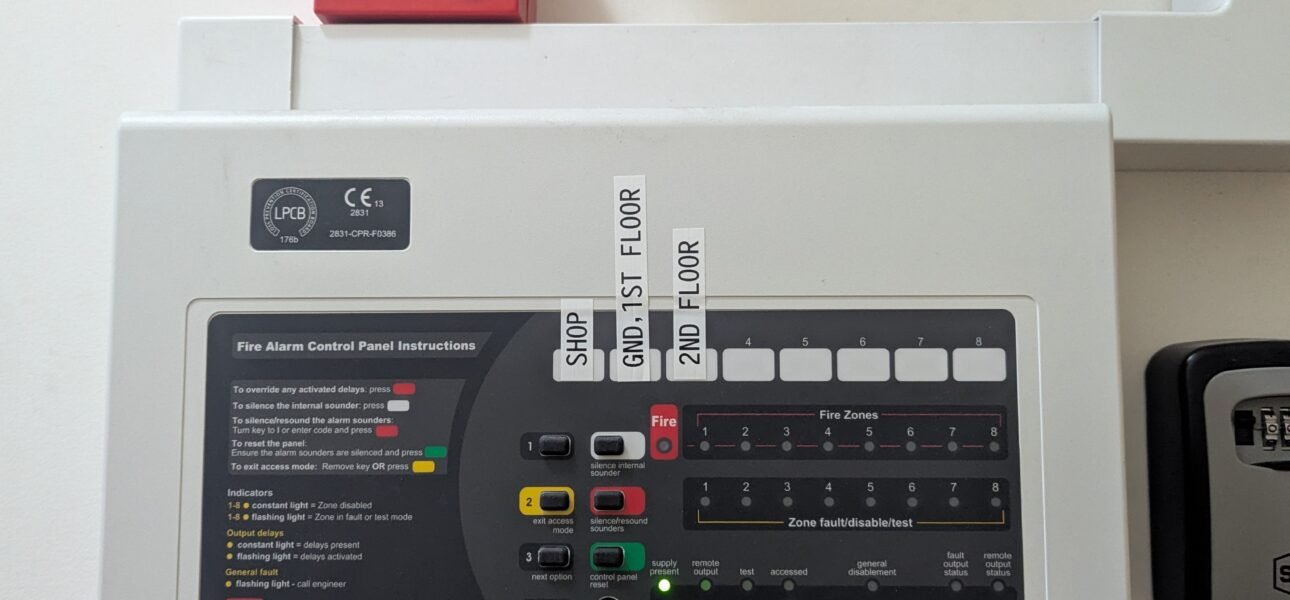
In commercial buildings and larger HMOs, the alarm is usually a system with a control panel. False alarms there often come from dirty or unsuitable detectors, building work, or a system that hasn’t been serviced.
BS 5839-1 recommends that fire alarm systems are serviced by a competent person at intervals of no more than six months. See our fire alarm servicing for more.
What to check when your fire alarm keeps going off
If you have a fire alarm going off regularly, these checks are safe to do yourself:
- First, check for any sign of a real fire, smoke or a burning smell
- Notice whether it happens when cooking, showering or using aerosols
- Then find which alarm triggered first, if your alarms are interlinked
- Check the date on the alarm, and replace it if it’s around 10 years old
- Gently vacuum around the vents with a soft brush attachment
- Finally, never remove the battery or disconnect an alarm to stop it going off
If it’s just chirping every minute or so, that’s usually a low battery rather than a false alarm. Read our guide on smoke alarm chirping.
How an electrician stops a fire alarm going off
We follow the same three steps every time, so your alarms protect you without crying wolf.
We find the trigger
We check which alarm or detector started it, where it’s fitted and when it happens.
We test the system
Then we test each alarm, the interlinks, the mains supply and the backup batteries, rather than guessing.
We fix and re-test
Finally, we move, replace or swap alarms for the right type and test the whole system, so it works when it matters.
Fire alarm going off: FAQs
Why is my fire alarm going off when there’s no smoke?
Usually it’s reacting to steam, cooking fumes or dust in the sensor. Older alarms can also become oversensitive, so check the date and replace any alarm that’s around 10 years old.
Why is my fire alarm going off in the middle of the night?
As the temperature drops at night, a weak backup battery can struggle, which can cause chirping or false alarms. In addition, dust and insects are common causes.
Why is every fire alarm going off at once?
Interlinked alarms are designed to sound together, so one alarm detecting something, or one faulty unit, sets them all off. Find the alarm that triggered first to locate the cause.
Can I disconnect a fire alarm that keeps going off?
No. It’s dangerous, and in rented homes it can breach the landlord’s legal duties. Instead, find the cause, move the alarm or replace it with the right type.
Which type of alarm should go in a kitchen?
A heat alarm, because it reacts to a rise in temperature rather than fumes. Smoke alarms, on the other hand, should be kept away from kitchens and bathrooms to avoid false alarms.
How much does it cost to fix a fire alarm that keeps going off?
It depends on the cause. For example, replacing a single alarm is a quick job, while finding a fault on an interlinked system takes longer. Send us a WhatsApp and we’ll give you a free quote.
Still got a fire alarm going off?
Our engineers are qualified to BS 5839-1 and BS 5839-6, so we can sort out false alarms in homes, HMOs and businesses. See our smoke alarm installation service, or message us for a free quote.
Speak to a London electrician today
Call, email or WhatsApp us for a free quote. For emergencies, we answer 24/7.
