
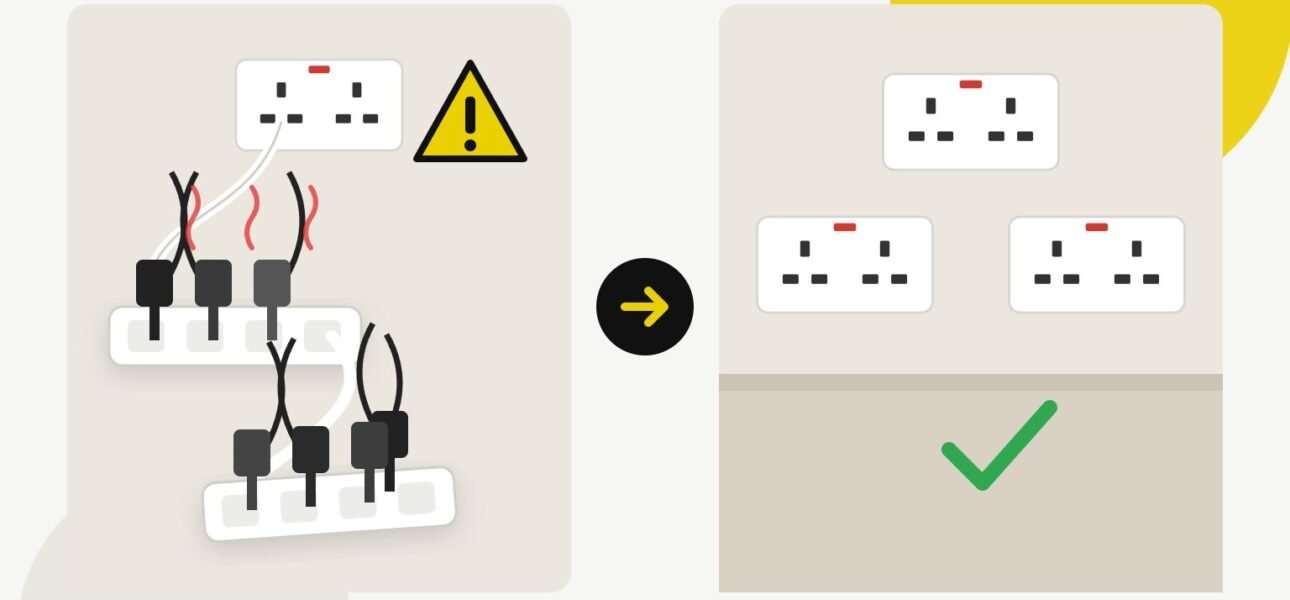
Behind the TV, under the desk, next to the toaster: most homes we visit have at least one extension lead doing a job a wall socket should be doing. Usually it's because the house was wired when people owned a lot fewer gadgets.
The good news is that adding extra sockets is often a simpler job than people expect. Here's why it's worth doing and what's involved.

How many sockets does your room really need?
Pick a room and tick what you plug in. We’ll show how many double sockets it needs, so you don’t have to rely on extension leads.
Why extension leads aren't a long-term fix
Extension leads are fine for occasional use, but they're easy to overload. A lead is rated at 13 amps in total, however many sockets it has. A kettle on its own uses most of that, so a kettle, toaster and microwave on one lead is asking for trouble.
Electrical Safety First advises against plugging one extension lead into another (daisy chaining), and says that if you regularly rely on them, you should think about having extra sockets fitted.
Signs your extension leads are being overworked
- Plugs or leads that feel warm
- A smell of hot plastic or burning
- Scorch marks on a plug, socket or lead
- Plug fuses blowing, or the lead's own switch cutting out
- Leads running under rugs or through doorways, where they get crushed
If you notice any of these, unplug it and stop using it.
Running out of sockets? We can add more, neatly and safely.
Where people usually need extra sockets
- Kitchens: worktop appliances have multiplied, with air fryers, coffee machines and microwaves all competing for space.
- Home offices: computers, monitors, chargers and printers.
- Living rooms: the TV, soundbar, games console and router.
- Bedrooms: bedside sockets, often with USB charging built in.
- Outside: a weatherproof socket for the lawnmower, pressure washer or Christmas lights. Our outdoor electrics guide explains why these need RCD protection.
Can you find all five hazards?
This room has five common extension lead mistakes. Tap anything that looks wrong.
- Stacked cube adaptor. Adaptors packed with plugs can overheat and pull the socket out of the wall.
- Daisy-chained leads. Plugging one extension lead into another makes it easy to overload the socket.
- Cable under a rug. It gets walked on and damaged where nobody can see, and the heat can’t escape.
- Coiled cable reel with a heater. A reel left wound up can overheat badly. Heaters should go straight into a wall socket.
- Taped-up cable. Tape isn’t a repair. A damaged cable should be replaced, not patched.
Well spotted. If your home has any of these, it’s time for more sockets.
What's involved in adding extra sockets
In most rooms we can add sockets to an existing circuit, or swap a single socket for a double. Under Part P, that isn't usually notifiable work unless it's in a bathroom.
For a kitchen full of appliances or a garden office, a new dedicated circuit may be the better option. That is notifiable, so it must be done by a registered electrician or signed off by building control.
Before adding to a circuit, we check it can take the extra load and that it's protected by an RCD. If the circuit is old or you still have an old fuse box, we'll tell you before we start.
Chased in or surface-mounted?
Chasing the cables into the wall gives the neatest finish, but it means some plastering and making good afterwards. Surface-mounted sockets with slim trunking are quicker and cleaner where you'd rather not disturb the walls, and they work well in offices, garages and rented flats.
Frequently asked questions
Is it safe to use extension leads permanently?
They aren't designed for it. Occasional use is fine, but if you rely on them every day, extra sockets are the safer option.
How much can I plug into an extension lead?
No more than 13 amps in total, which is about 3,000 watts. A kettle on its own can use most of that.
Do I need building control to add a socket?
Adding a socket to an existing circuit isn't usually notifiable, except in bathrooms. A new circuit is notifiable and should be done by a registered electrician.
Can you add sockets without chasing the walls?
Yes. Surface-mounted sockets and trunking are an option where you'd rather not disturb the plaster.
Can I swap a single socket for a double?
Yes, and it's usually a quick job.
Fed up with extension leads?
We add extra sockets in homes across London, chased into the wall or surface-mounted, and test every one. Message us with the rooms you’d like sockets in for a free quote.
Speak to a London electrician today
Call, email or WhatsApp us for a free quote. For emergencies, we answer 24/7.
