
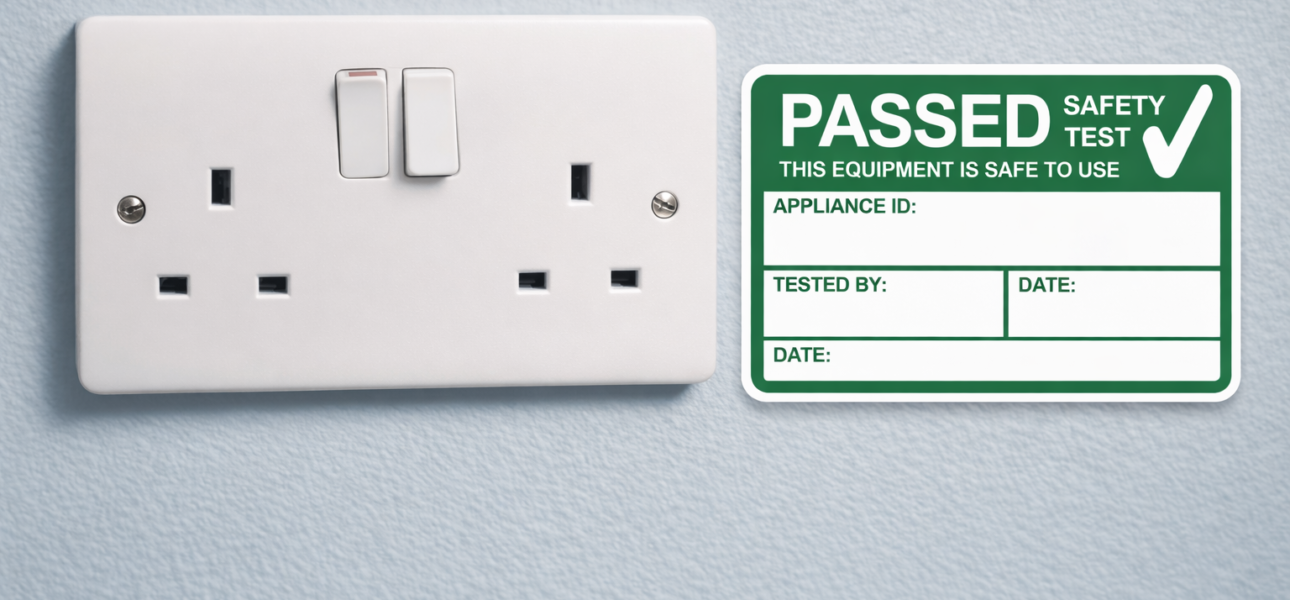
Does my office or shop need PAT testing?
PAT testing for businesses isn’t written into law as such, but the law does require you to keep electrical equipment safe. Under the Electricity at Work Regulations 1989, employers must maintain equipment so it doesn’t cause danger, and PAT testing is the simplest way to show you’ve done that.
In practice, most offices, shops, salons and restaurants in London have their portable appliances inspected and tested regularly, and many insurers and landlords expect to see the records. This guide explains what’s required, how often to test and how to keep it simple.

Tap an appliance to see how it’s tested
PAT testing depends on how an appliance is protected. Class II items carry a double-square symbol and don’t need an earth test.
What the law says about PAT testing for businesses
The Electricity at Work Regulations 1989 and the Health and Safety at Work Act require employers to keep electrical equipment in a safe condition. However, they don’t specify PAT testing or a fixed interval.
Instead, the Health and Safety Executive and the IET Code of Practice recommend a risk-based approach. Therefore, how often you test depends on the type of equipment, how it’s used and the environment it’s in.
Need your equipment tested? We PAT test offices, shops, salons and restaurants across London.
PAT testing for businesses: common myths
A lot of what you hear about PAT testing isn’t quite right. Here’s what actually applies.
PAT testing is a legal requirement every year.
The law requires equipment to be kept safe, but it sets no fixed interval. How often you test should be based on risk.
Brand-new equipment needs testing straight away.
New items usually only need a visual check and adding to your register, then they join your regular testing.
Only an electrician is allowed to do PAT testing.
Anyone competent with the right training and equipment can. However, an electrician can also fix simple faults on the spot.
Office IT needs testing as often as everything else.
Low-risk office equipment usually needs testing less often than kettles, heaters and extension leads.
A PAT sticker means the building wiring is safe too.
PAT testing only covers plug-in equipment. The fixed wiring needs a separate EICR.
What equipment does PAT testing for businesses cover?
PAT testing for businesses usually covers anything with a plug that your staff or customers use.
Kitchen appliances
Kettles, microwaves, toasters and fridges in staff kitchens, which are used heavily and often by many people.
IT equipment
Computers, monitors, printers and phone chargers. These are lower risk, so they usually need testing less often.
Extension leads
Extension leads and adaptors are among the most commonly failed items, because they’re moved, stretched and overloaded.
Heaters and fans
Portable heaters work hard in winter. As a result, they’re worth checking before the cold weather starts.
Cleaning kit and tools
Vacuums, floor polishers and power tools are moved and plugged in constantly, so their leads and plugs take a lot of wear.
Staff’s own equipment
Phone chargers, radios and desk fans that staff bring in still use your sockets. Therefore, it’s sensible to include them too.
PAT testing checklist for businesses
Before your next test, make sure you:
- Know roughly how many plug-in appliances you have, including staff items
- Check the date of your last PAT test and when it’s next due
- Ask staff to report damaged leads, plugs or scorch marks straight away
- Take anything damaged out of use until it’s been checked
- Keep your test register and labels up to date
- Finally, book testing at a quiet time, so equipment can be unplugged without disruption
PAT testing covers plug-in equipment only. Your fixed wiring needs a separate check, called an EICR.
How we carry out PAT testing for businesses
We can usually arrange testing at a time that suits your business.
We list your equipment
We record every appliance, so you end up with a full register of what you have.
We inspect and test
Then we visually inspect each item and test it, including earth continuity and insulation checks.
We label and report
Finally, each item gets a pass or fail label, and you get a report and register for your records.
PAT testing for businesses: FAQs
Is PAT testing a legal requirement for businesses?
Not as such. The law requires you to keep electrical equipment safe, and PAT testing for businesses is the most common way to show you’ve done that. Many insurers also expect it.
How often should an office have PAT testing?
There’s no fixed interval in law. The IET Code of Practice suggests longer intervals for low-risk office equipment and shorter ones for items that are moved around or used heavily, so a risk assessment sets the timing.
Does new equipment need PAT testing?
Brand-new equipment usually only needs a visual check and adding to your register. However, it should then be included in your regular testing.
Who can carry out PAT testing?
Anyone competent to do it, with the right training and test equipment. Using a qualified electrician also means simple faults, such as the wrong fuse, can often be fixed on the spot.
Does PAT testing cover the building’s wiring?
No. PAT testing only covers plug-in equipment. The fixed wiring is checked with an EICR, which businesses should also have done periodically.
How much does PAT testing for businesses cost?
It depends mainly on how many appliances you have. Send us a rough count on WhatsApp and we’ll give you a free quote.
Need PAT testing for your business?
We carry out PAT testing for offices, shops, salons and restaurants across London. See our PAT testing service, or message us for a free quote.
Speak to a London electrician today
Call, email or WhatsApp us for a free quote. For emergencies, we answer 24/7.
